
For over two decades, Hikeylove has pioneered the integration of educational philosophy, child psychology, and purposeful design to create learning environments that do more than furnish a room—they actively nurture growth.
Walk into any early childhood classroom, and you'll immediately sense its personality. Some spaces feel chaotic and overwhelming, with cluttered shelves and mismatched furniture competing for attention. Others feel like a warm embrace—calm, inviting, and somehow knowing exactly what children need. This isn't magic. It's intentional design.
At Hikeylove, we've spent 25 years exploring a question that continues to guide everything we create: How can the physical environment become an active participant in a child's development? The answer has led us from a small workshop in Zhongshan to partnerships with over 20,000 educational institutions worldwide, and to a profound understanding that the best learning spaces are those that fade into the background—so childhood can take center stage.
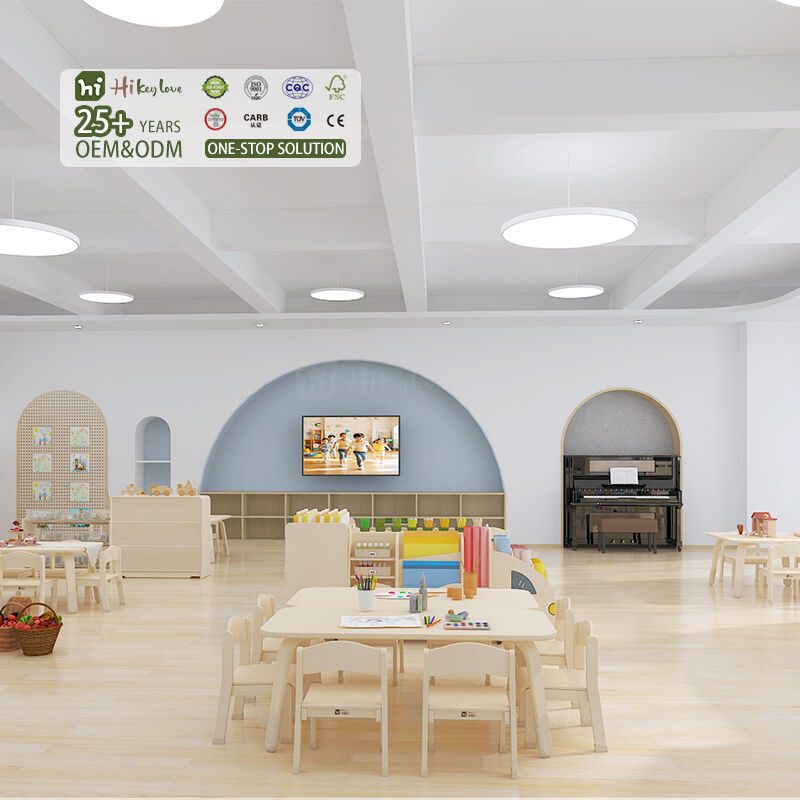
The concept of the environment as the "third teacher" originated in the Reggio Emilia approach, which recognizes that children learn not only from their teachers and peers but also from the spaces they inhabit. Every element of a thoughtfully designed classroom—the height of a shelf, the curve of a table, the warmth of natural materials—communicates something to the child.
A low, open bookshelf says, "Come explore. These books are for you. You are trusted to choose." A soft, rounded reading nook whispers, "You are safe here. Stay awhile." A modular play unit invites, "What will you create today? The possibilities are endless."
This philosophy aligns perfectly with our core values at Hikeylove: to see children's developmental needs, to honor their natural rhythms, and to support their unique path of growth. We don't just build furniture; we create tools for independence, confidence, and discovery.
Beautiful furniture is wonderful. But beautiful furniture that teaches? That's where the magic happens. Hikeylove was the first in our industry to apply environmental perception theory to early childhood space design. This framework recognizes that children perceive and interact with their environment through multiple lenses—psychological, sensory, and spatial.
Consider how a child experiences a classroom:
Psychologically: Does the space feel safe and predictable? Can they find what they need without frustration? Do the colors calm or overstimulate?
Sensory-wise: What textures do their hands encounter? How does light move through the room? What sounds are absorbed or amplified?
Spatially: Can they move freely? Are there cozy corners for quiet moments and open areas for collaboration? Does the layout guide them naturally toward meaningful activity?
These aren't afterthoughts. They're the foundation of everything we design.
Our Lumin Forest Series, for example, brings nature indoors with warm wood tones and organic curves. Research consistently shows that natural materials and forms reduce stress and support cognitive function in young children. The rounded edges aren't just safety features—they're visual cues that soften the environment and invite gentle interaction. The open, accessible storage isn't just practical—it empowers children to take ownership of their space and materials.
Children don't learn in isolation. They move, play, rest, create, explore, and connect throughout their day. A truly supportive environment honors this wholeness. That's why we organize our approach around what we call the "Six Spaces" of early childhood education:
1. Activity Rooms: Where focused learning happens. Our adjustable-height tables and flexible seating adapt to different activities and growing bodies.
2. Function Rooms: Specialized spaces for art, music, or movement. Here, modular furniture transforms to support each unique purpose.
3. Public Spaces: Hallways, lobbies, and gathering areas. These transitional zones set the tone for the entire facility.
4. Nursery & Toddler Spaces: For our youngest learners, safety and sensory warmth are paramount. Our Soft & Serene Series features fully upholstered elements and gentle colors that soothe and protect.
5. Outdoor Environments: Learning extends beyond four walls. Our outdoor solutions bring durability and intentional design to nature-based exploration.
6. Staff & Administrative Areas: Supporting the adults who support children is equally important. Thoughtful teacher spaces honor their work and well-being.
Each of these spaces serves a distinct purpose, yet together they form an integrated ecosystem that supports the whole child—and the whole community of learners and educators.
Perhaps the most important principle guiding our work is this: play is the work of childhood. When children build with blocks, they're not just stacking—they're experimenting with physics and balance. When they role-play in a market stall, they're not just pretending—they're practicing social negotiation and early math. When they lose themselves in a story corner, they're not just listening—they're building the neural pathways for empathy and imagination.
Our products are designed to amplify these natural learning processes. Our modular "Magic Box" units can be configured into stages, storage, or platforms, giving children the power to shape their own environment. Our geometric bookshelves introduce shape recognition through daily interaction. Our role-play sets create authentic contexts for language development and social-emotional learning.
This is what we mean when we say we design for "learning through play, playing to learn." Every curve, every shelf, every carefully considered detail is an invitation to discover.
When you choose Hikeylove, you're not just purchasing furniture. You're partnering with a team that shares your commitment to children's well-being and development. Our 500+ team members across four factory zones work daily to ensure every piece meets the highest standards of safety, durability, and educational value.
But more than that, we listen. We learn from educators like you—from the challenges you face, the moments of wonder you witness, the dreams you hold for the children in your care. Your insights shape our designs. Your feedback drives our innovation.
As we look toward the next 25 years, our commitment remains unwavering: to be more than a furniture manufacturer. To be true partners in creating environments where children can flourish. To continue learning, evolving, and leading—not just as a company, but as advocates for the transformative power of thoughtful design in early childhood education.
The environment is the third teacher. We're honored to help you build yours.

Leading Chinese brand for 20+ years, supplying eco-safe, design-driven kindergarten furniture & turnkey space solutions to 10,000+ preschools worldwide.
No. 26 Gongye Avenue, Shunjing Industrial Park, Banfu Town, Zhongshan City, Guangdong Province
Copyright © 2026 Zhongshan Haijilun Cultural And Educational Product Co., Ltd.. All rights reserved. Privacy Policy