
As educators and school leaders, you know the profound responsibility of shaping young minds. You curate lessons, foster social skills, and nurture curiosity. But what if one of your most powerful teaching tools has been silently overlooked? At Hikeylove, we believe the physical space of a classroom is not a passive container, but an active participant in learning. The movement toward intentional early childhood classroom design trends marks a pivotal shift from viewing furniture as mere equipment to recognizing it as fundamental, interactive architecture for development.
This article explores how to move beyond basic procurement and leverage your environment—through material choices, layout, and furniture—to directly support advanced pedagogical goals, foster well-being, and create truly effective, play-based learning environments.
The journey toward an impactful classroom begins with the elements children touch and see every day. The current shift toward natural materials is a response to deeper developmental needs, not just aesthetics.
Sensory Intelligence and the Benefits of Natural Materials: A plastic toy is often uniform in weight, temperature, and texture. Contrast this with the sensory-rich experience of solid wood, woven fiber, or supple leather. These natural classroom materials offer authentic feedback—a wooden block has a distinct weight and grain; a woven basket has flexibility and sound. This sensory diversity is crucial for brain development, helping children build neural pathways as they discern differences in texture, temperature, and resistance. It grounds them in the tangible world, fostering calm and connection. Choosing such materials is a cornerstone of sustainable preschool design, teaching stewardship through embodied experience and ensuring the environment itself is non-toxic and healthy.
The traditional, front-facing classroom model inherently centralizes authority and limits movement. Modern pedagogy demands a space that liberates.
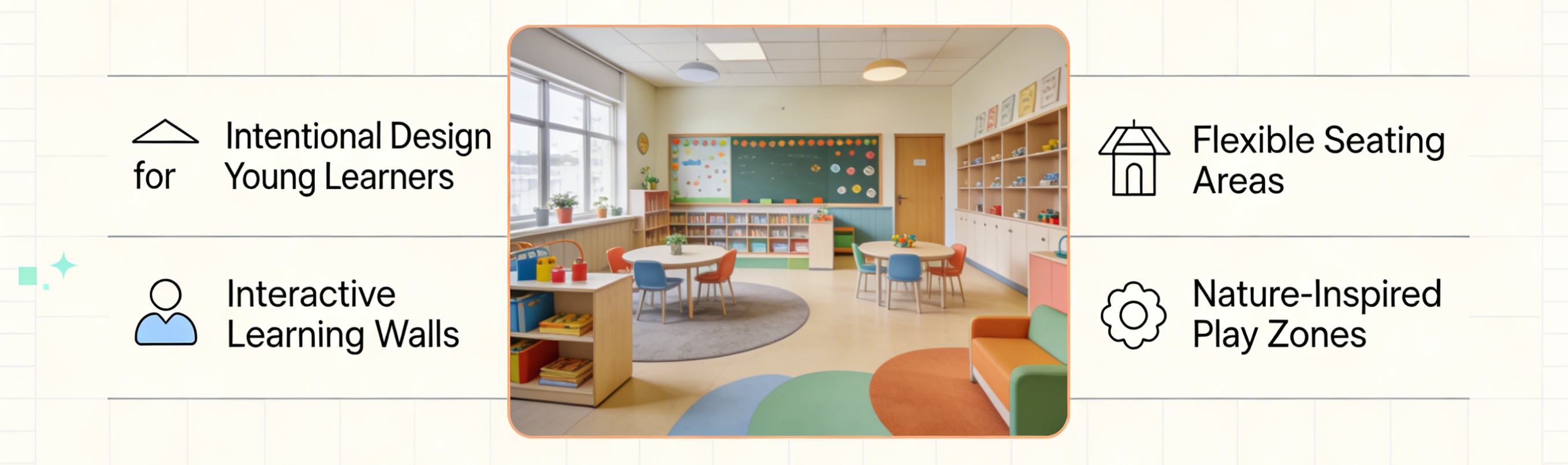
Cultivating Agency Through Design: The importance of flexible seating and adaptable layouts cannot be overstated. It is fundamentally about granting children agency over their own bodies and learning processes. Can a child choose to stand, kneel on a soft pad, or sit on a wobble stool to find their optimal focus zone? This autonomy is a prerequisite for deep engagement. When selecting furniture, consider pieces that are lightweight, modular, and multi-functional. Our kindergarten furniture buying guide principle is simple: if it can’t be easily moved by a child or teacher to serve a new purpose, it limits potential. This flexibility directly supports higher ECERS rating scores in dimensions related to space, furnishing, and child-directed activities.
Beneath the visible appeal of a classroom lies an invisible framework of systems and safety that dictates daily rhythm and emotional climate.
Systemic Thinking for Independence: Effective classroom organization tips go beyond tidy bins. They involve creating logical, consistent systems that children can internalize. When every material has a clear, accessible home marked with visual cues, children are not just cleaning up—they are engaging in pre-mathematical classification, logical sequencing, and executing a plan. This empowers independence and reduces teacher-directed management, freeing educators to observe and interact meaningfully.
Designing for Belonging: Creating inclusive classrooms means designing spaces where every child, regardless of physical ability, sensory preference, or emotional temperament, can participate fully. This includes providing varied seating options, creating quiet retreat zones for overstimulation, and ensuring clear pathways. Emotional safety is fostered by soft forms, muted color palettes that reduce cognitive load, and cozy enclosures that offer a sense of privacy and control. Inclusion is thus woven into the very fabric of the environment.
For over two decades, Hikeylove has translated these insights into tangible, beautiful, and robust solutions. Our designs serve as the building blocks for your educational vision.
Our Modular Sorting Cabinet is the epitome of systemic thinking. Its clear grid and labeling transform cleanup into a cognitive exercise in sorting and responsibility, making the abstract concept of “order” tangible for a young child.
Our collection of flexible seating and height-adjustable tables forms the dynamic landscape of the classroom. They are designed to be rearranged by children, promoting collaboration and ensuring the space can evolve from a science lab to an art studio to a reading den in moments.
Our Woven Nooks and tranquil reading areas provide essential “away” spaces within the classroom. These deliberately crafted retreats support emotional regulation, offering a sanctuary for a child to reset, a critical component for maintaining a harmonious play-based learning environment for all.
Ultimately, how to choose preschool furniture is the wrong first question. The essential inquiry is: What experiences do you want to make possible? Once you define the learning, social, and emotional experiences you value, the furniture choices become clear and purposeful.
We invite you to see your next classroom project not as a furnishing task, but as an opportunity to architect an ecosystem for human potential. Let’s collaborate to create spaces that don’t just hold children, but hold their attention, their wonder, and their growing sense of self. The goal is a classroom that works as intentionally as you do.
Explore our curated collections designed with these principles, or reach out to our team to begin a conversation about the experiences you wish to build.

Leading Chinese brand for 20+ years, supplying eco-safe, design-driven kindergarten furniture & turnkey space solutions to 10,000+ preschools worldwide.
No. 26 Gongye Avenue, Shunjing Industrial Park, Banfu Town, Zhongshan City, Guangdong Province
Copyright © 2026 Zhongshan Haijilun Cultural And Educational Product Co., Ltd.. All rights reserved. Privacy Policy